In this blog, I recommend ten brilliant books that feature main characters with LGBT+ parents, and discuss why it’s important that all children get the opportunity to read them.
February is LGBT+ History Month – a time for commemorating the incredible things LGBT+ people have achieved throughout history, celebrating our present, and creating our future.
Over the past 50+ years Schools OUT have worked to #educateOUTprejudice and usualise LGBT+ lives, creating learning environments where all LGBT+ people feel safe, seen, and supported.
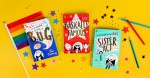
Like me, there are many authors working to normalise LGBT+ parents in children’s literature for the same reasons. Indeed, one of the main reasons I wrote my debut novel, The Accidental Diary Of B.U.G., was because my son was craving a funny, doodle-heavy book that featured a positive representation of a family like ours (2 mums, adopted children) – which I’ve previously blogged about here.
Positive Representation
It’s imperative that children with LGBT+ parents get opportunities to see a positive reflection of their very normal families in a good book for many reasons, not least of which is because representation is the key to successful reading for pleasure.

When a child sees themselves in a book, they feel validated, their self-confidence sky-rockets as they realise they’re not alone. Moreover, they’re more likely to read for pleasure and, if this habit is sustained, they’ll have better life chances, get better grades and report higher levels of wellbeing.
Understanding of difference
It’s of equal importance that all children have the opportunity to read great stories that, incidentally, contain families unlike their own. It helps them make sense of the world around them, boost their empathy levels and gain a deeper understanding of ‘different’ (and a recognition of the many similarities that unite humans).
Recommendations
That being said, here are ten recommendations from me for anyone seeking out fantastic books for your home, classroom or library, all of which feature main characters with LGBT+ parents.
Ten great children’s books featuring LGBT+ parents.
1. My Daddies by Gareth Peter and Garry Parsons
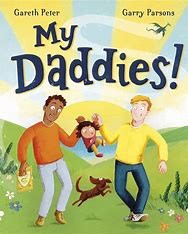
This heartfelt rhyming board book champions same-sex parents and the magic of reading between two dads and their adopted daughter.
PUBLISHER’S BLURB:
Set off on a series of incredible adventures with an adorable family as the stories they read burst into colourful life. Battle dragons, dodge deadly dinosaurs, zoom to the moon and explore the world in a hot air balloon, before winding down in a wonderfully cosy bedtime ending.
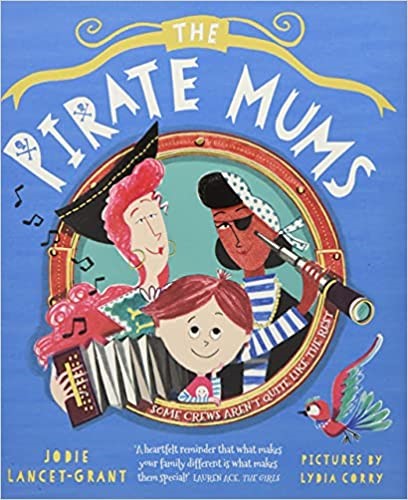
2. The Pirate Mums by Jodie Lancet-Grant and Lydia Corry
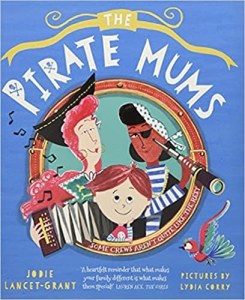
This swashbuckling adventurous picture book is perfect for introducing young children to the idea that families come in lots of shapes and sizes in a fun way.
PUBLISHER’S BLURB:
Billy’s family is not what you’d call ordinary. His mums won’t listen to NORMAL music. They love to sing sea shanties and dance jigs in the lounge. Their clothes are highly unusual, they have a rude parrot for a pet, and their taste in house design is, well . . . FISHY. Billy wishes his family could be more like everyone else’s, until an ocean adventure changes everything!
3. The Secrets of Sam and Sam by Susie Day
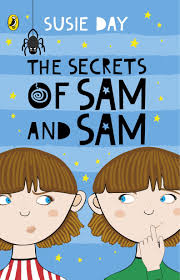
In this funny story about modern family life, the two Sams are m/f twins with the same mums and the same name, but very different personalities and lots of secrets.
PUBLISHER’S BLURB:
Sam likes being a twin. He likes having two mums. He likes cheese sandwiches and his dog and drawing comics with his friend Pea. He does not like humus – or heights . . .
His twin sister Sammie likes being a twin too. She knows that she’s perfect best friend material for somebody – the girls in her class just haven’t realised yet. And she knows that she’s the best Sam – Sam A.
Both Sam and Sammie – and everybody in their lives seems to be keeping secrets – which ones will come out?
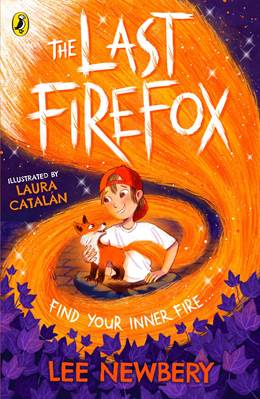
4. The Last Firefox (3 book series) by Lee Newbury
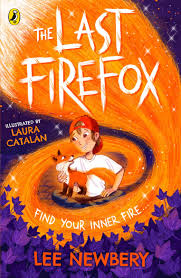
Two loving dads support their adopted son in this exciting fantasy adventure about a young boy who rescues a magical firefox cub.
PUBLISHER’S BLURB (for book 1):
Between bullies at school and changes at home, Charlie Challinor finds life a bit scary. And when he’s made guardian of a furry fox cub called Cadno, things get a whole lot scarier.
Because Cadno isn’t just any fox: he’s a firefox – the only one of his kind – and a sinister hunter from another world is on his trail.
Swept up into an unexpected adventure to protect his flammable friend, Charlie’s going to need to find the bravery he never thought he had, if he’s going to save the last firefox . . .
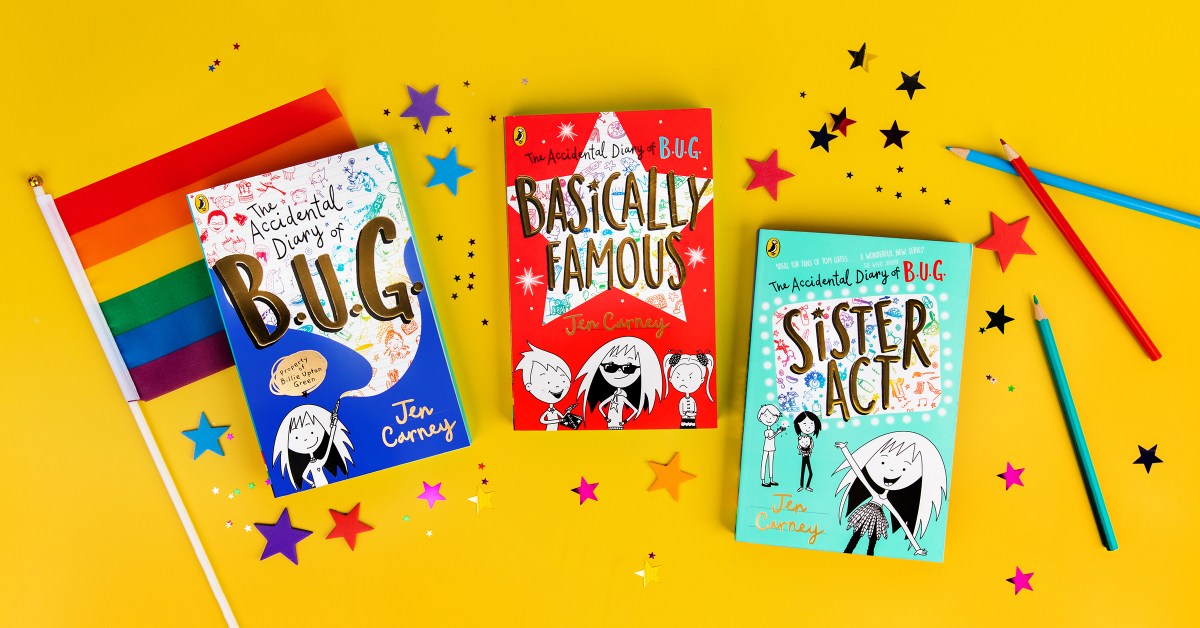
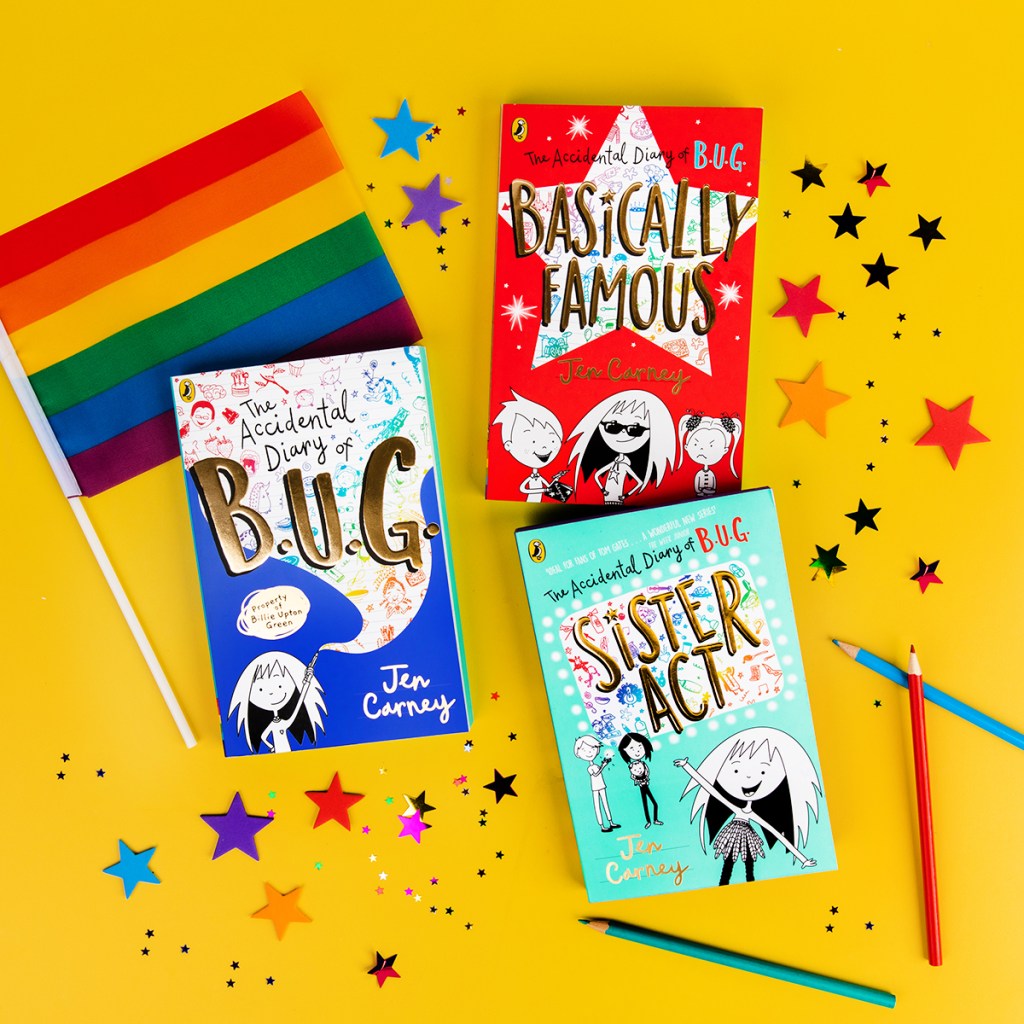
5. The Accidental Diary of B.U.G. (3 book series) by Jen Carney
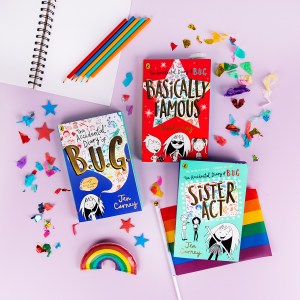
This is a laugh-out-loud contemporary diary series rooted firmly in reality and narrated by the sparky Billie Upton Green who, incidentally, was adopted by her two mums when she was a baby.
PUBLISHER’S BLURB (for Book 1):
Meet Billie Upton Green and her VERY accidental diary – and don’t you DARE call her B.U.G!
Billie has taken the new girl at school under her wing. She’ll teach her the important stuff – Biscuit Laws, Mrs Patterson and of course where to sneakily eat a Jaffa Cake. She might even get invited to the EVENT OF THE YEAR (Billie’s mums’ are getting married).
But then suspicion sets in. The new girl seems VERY close to Billie’s best friend Layla.
And she knows a LOT about the big school heist – the theft of Mrs Robinson’s purse. But, Billie is on to her. Well, as long as Patrick doesn’t catch her eating biscuits first.
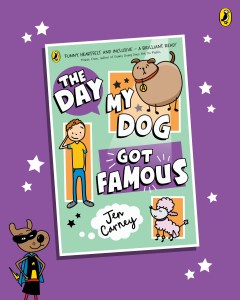
6.The Famous Series (3 books) by Jen Carney
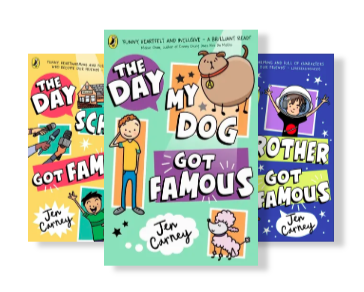
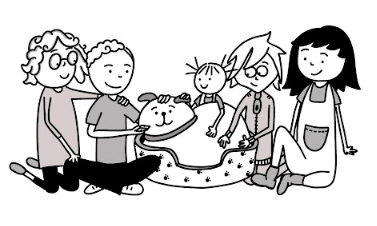
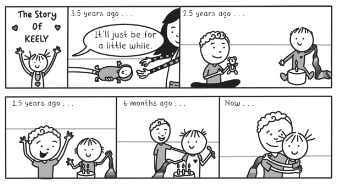
The protagonist of these funny realistic adventure stories is a kind-hearted boy called Ferris who opens his home and his heart to the children his two mums foster for varying lengths of time.
PUBLISHER’S BLURB (for Book 1):
A few things you should know about Ferris Foster:
1. He’s the cartooning genius behind ASTOUNDOG (star of The Hoot, available exclusively in his school playground)
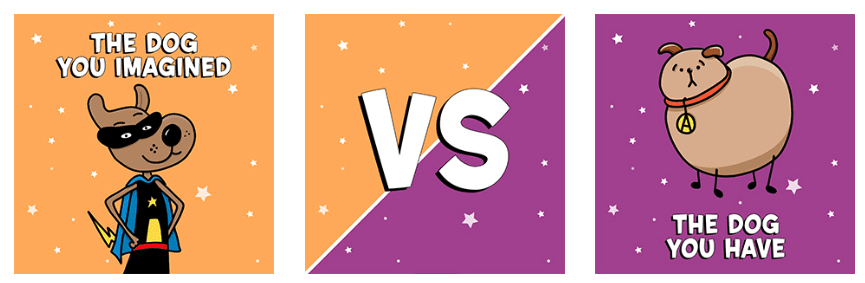
2. His best friend is his actual dog, Aldo who is anything but astounding
3. He’s had 13 foster brothers and 8 foster sisters and now he’s about to meet his new foster sister, Tia, for the first time
4. His NEMESIS is his totally annoying neighbour Destiny Dean!
When Destiny boasts about videos of her dog, Princess Foo-Foo, going viral, Ferris foolishly claims that Aldo can easily become a BIGGER internet star.
There’s just one problem: Aldo has about as much talent as a teaspoon.
Then Ferris and Tia accidentally film Aldo doing what looks like an amazing trick . . . will Aldo finally live up to the name of his comic book alter-ego and wow the world with his skills or is this about to be the biggest EPIC FAIL ever?
7. The Dad Trap by Ian Eagleton
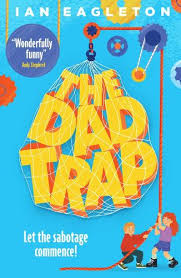
Instant enemies William and Florence are horrified to find out their dads are dating each other – and are forced to work together to split them up!
PUBLISHER’S BLURB:
When William and Florence meet on the first day of Year Six, they instantly dislike each other.
William is impulsive, endlessly chatty and struggles in school. His home life is safe and predictable – just him and Dad, who adopted him as a solo parent – and that’s how William likes it.
Florence is sullen, cold, and everything seems to come easily to her. She’s moved after her parents’ divorce – but she’s convinced she won’t be staying long because they’ll definitely get back together…
But then Florence and William find out that their dads have started seeing each other. Now they must put their differences to one side. Because only if they work together might they stand a chance of splitting up their dads… Let the sabotage commence!
8. The Doughnut Club by Kristina Rahim
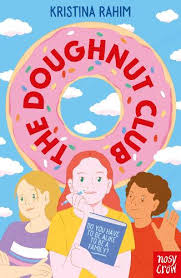
This is a heart-warming and relatable story about donor conceived siblings Quinn and Olly who have two mums, and sixteen donor siblings.
PUBLISHER’S BLURB:
Donor conceived Quinn loves her family, but she often feels the odd one out. Not only because she’s the only one with red hair and green eyes, but because she would rather be quietly drawing than surfing or rock-climbing or whatever mad activity her mums and brother Olly might like to do on holiday.
But when Quinn’s mums tell her and Olly they have sixteen donor siblings, Quinn is really excited. Maybe one of them will be more like her! The only problem is her parents want them to wait until they are older to contact anyone.
As she tries to secretly find out more, Quinn starts to lose sight of what’s really important – especially when she starts to believe her worst enemy could be one of her siblings!
Can Quinn find a way back to her family, whilst finding a way to tell them how she really feels?
9. Nate Yu’s Blast From The Past by Maisie Chan
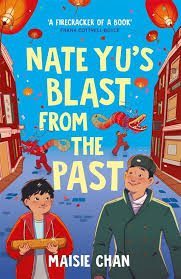
This is a captivating story steeped in history narrated by Nate (who has two mums) that explores identity, friendship, family and belonging.
PUBLISHER’S BLURB:
Nate Yu Riley loves three things: his Switch, his ant farm (especially Betsy, queen of the colony) and his family.
He’s not so sure about some other things, like moving to a big city, starting a new school, and his parents making him do Chinese stuff. They’re always trying to get him to embrace his heritage, but Nate can’t speak Chinese, and he doesn’t know anything about Chinese customs.
But when Nate comes across an old shell casing engraved with a Chinese dragon, he can’t stop thinking about it. And when he touches the shell, someone extraordinary appears. A ghost from long ago. Someone who needs Nate’s help – and Nate might just need his, too …
10. Nothing Ever Happens Here by Sarah Hagger-Holt
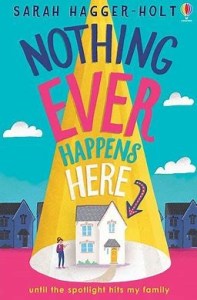
In this engaging and compassionately told story, Izzy’s family is under the spotlight when her dad comes out as Danielle, a trans woman.
PUBLISHER’S BLURB:
This is Littlehaven. Nothing ever happens here. Until the spotlight hits my family.
Izzy’s family is under the spotlight when her dad comes out as Danielle, a trans woman. Izzy is terrified her family will be torn apart. Will she lose her dad? Will her parents break up? And what will people at school say? Izzy’s always been shy, but now all eyes are on her. Can she face her fears, find her voice and stand up for what’s right?




 Jen Carney