Categories
Engaging reluctant readers Reading for pleasure Uncategorized

The Hidden Benefits of Funny Books for Kids

Why should children read funny books?

1. Comedy provides a welcome escape from the chaos of the world

Who doesn’t sometimes just need a good old belly laugh?

2. Humour helps children cope

These days, funny books for children are way more than fart jokes and toilet humour. They often carry profound and deep messages, introduce young readers to meaningful or sensitive topics, and help them to navigate difficult situations.

As many writers of funny books might tell you (and, yes, I am one of them), ‘funny’ is the opposite of ‘not funny’, not of ‘serious’.
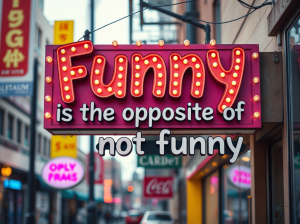
In other words, something can be both funny and serious at the same time. 

Without doubt, it is the author building trust with a reader through humour that allows for exploration of more sensitive issues.

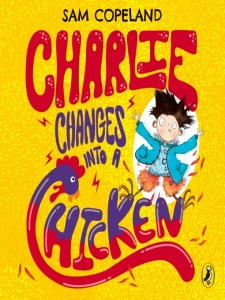
In the hilarious book, Charlie Turns Into A Chicken, by Sam Copeland, Charlie turns into different animals when he’s feeling anxious. And one of his main anxieties comes from the fact that his brother has cancer.
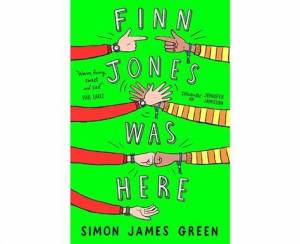
In Finn Jones was Here, by the talented writer, Simon James Green, themes of grief and death are explored through humour.
3. Laughter really can be the best medicine

A good old giggle can help counteract feelings of anxiety in children. Don’t just take my word for it, listen to scientific fact: 

Laughing produces endorphins. These ‘happy hormones’ promote a sense of well-being and help relieve stress. Similarly, when we smile, levels cortisol (a stress hormone) are reduced. 

So, reading a book that makes you smile or laugh, is truly beneficial for emotional well-being.

4. Sharing funny stories improves human connections

Whether through a shared read in class, or a bedtime story at home, when you laugh together, you bond better. Bonding over laughter develops trust which leads to open communication.

Reading a funny book can break down barriers and open up conversations. Once at ease, children speak more easily about sensitive topics.

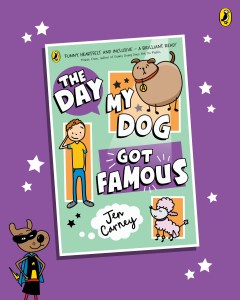
A teacher once contacted me to tell me that reading The Day My Dog Got Famous as a class reader had led to a brilliant discussion about different kinds of families, led by a child who’d lived with a foster family for a while before being adopted by two mums, just like Ferris’s.
PS the endorphins produced through laughter also promote better sleep! Winner winner.
5. Funny books can be empowering and reassuring

Humour can help children feel more comfortable, face fears or try something new. Seeing characters slip up, get into muddles and experience similar anxieties to their own can be reassuring.

Learning to laugh at yourself is a great life skill.

6. Funny books have the power to help children fall in love with reading

If a child associates reading with laughter and fun, they will have more chance of falling in love with reading.

Finding a funny book that hooks a child will entice them to read the whole series. Wimpy Kid, Loki, Dog Man – all very funny book series that have made children into readers.

PS Finding books that help children to read for pure joy is vital given that ‘reading for pleasure’ in childhood is evidenced to increase a child’s likelihood of achieving their potential in life.

7. Some funny novels have the power to compete with screens

The pay-off of a good laugh can be attractive enough to take a child away from a screen!

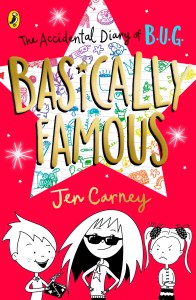
I’ll never forget the message I got from a parent who told me her son had CHOSEN to read Basically Famous instead of going on his PlayStation one evening.
And my own daughter will drop everything if there’s a new Lottie Brooks book out.

Less screentime = better mental health, in my opinion.

8. Funny books are brilliant teaching tools

We tend to remember things that make us laugh, so funny stories are brilliant for enhancing comprehension skills.

Funny books often contain moral dilemmas, so they improve social and emotional skills, and promote good decision making.

Puns, alliteration, word play, amusing similes…funny books contain them all, helping children to understand nuances of language.

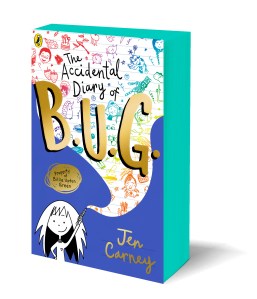
In The Accidental Diary of B.U.G., through masses of belly laughs, children are introduced to same-sex parenting and adoption – an excellent resource for PSHE/RSE lessons in primary schools when learning about different families.
I’d love to hear your thoughts. Do you have any other compelling arguments as to why children should read funny books?

Categories
Engaging reluctant readers The Accidental Diary of B.U.G. Uncategorized

Why is The Accidental Diary of B.U.G. series so interactive?

When I was writing The Accidental Diary of B.U.G., I had my own son in mind. Overwhelmed by books that were just pages and pages of just text, he’d quickly lose interest. He liked books with illustrations, but even those weren’t always enough to keep his interest.

That’s why The Accidental Diary of B.U.G. series is packed with things to do.

The distractions are within the book. They’re all relevant to what’s going on in the story, and they all involve reading. Sneaky, hey! Yes, but also effective!

Here are just a few examples:

Fun decision-makers

Children have said they love working their way through these. Some even make their own up after seeing one in a chapter, so they go on to practise writing and logical thinking too. 😊

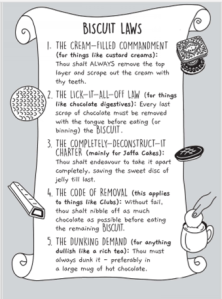
Biscuit Laws!

Biscuits are one of the series’ less-serious themes (although, as a biscuit-lover myself, I could argue that this is a VERY serious series-spanning topic!).

This picture shows the first five laws Billie and her TOBLA (The Official Biscuit Law Association) pals invent, but more are added as the series continues. Not only do children love reading these, they like debating their merits, trying them out and writing their own.

Games to try

The Accidental Diary of B.U.G. describes a lot of games that Billie plays in class and with her friends. As well as reading the rules, children can test them out which usually involves giving clear instructions to their friends.

Drawing activities

There are lots of drawing activities peppered through the series. Like the example below, many involve a bit of reading!

Bonus Blog content!

I love games. I’m a fan of playing games during long car journeys.

Here are five of my favourites that don’t require any equipment.

Try them on your next journey and see how quickly time passes! (Or, if games aren’t your thing, why not listen to a fun audiobook? Here’s a link to mine! my audiobooks)

Fun games to play on a car journey:

1. FORTUNATELY, UNFORTUNATELY

(as played by Billie and her class in The Accidental Diary of B.U.G.)

Rules:

  1. One person says a sentence to start a story.
  2. The next person continues the story, but they must start with the word unfortunately – essentially describing something that hinders things.
  3. The next player continues the story, but must start with the word fortunately and, in doing so, try to rectify the unfortunate event that has just happened.
  4. This continues until it gets too silly or boring, at which point you start again, or try the next game.

Example:

PLAYER 1: Derek jumped into his car and began to drive to a theme park.

PLAYER 2: Unfortunately, he’d only been driving for five minutes when he got a flat tyre…

PLAYER 3: Fortunately, he had a pump in his boot.

PLAYER 1: Unfortunately, the pump was broken.

PLAYER 2: Fortunately, Derek was a member of the AA, so called for help and the tyre was soon fixed.

(TIP: It’s good to resolve things along the way like this so that the story can continue)

PLAYER 3: Unfortunately, when Derek arrived at the theme park, he realised he’d left his wallet at home, so couldn’t buy a ticket.

PLAYER 1: Fortunately, his friend, Mary, who he was meeting, lent him £20.

PLAYER 2: Unfortunately, the tickets were £30.

PLAYER 3: Fortunately, Mary also had a £10-off voucher which she gave to Dereck and they entered the park.

PLAYER 1: Unfortunately, the roller-coaster Derek really wanted to go on was shut due to strong winds.

PLAYER 2: Fortunately, Mary was a weather weaver and ordered ten minutes of calm, sunny skies.

(TIP: It’s fine to include a fantasy!)

(TIPThis game works best with three or more people. )

Here are some sentences to start your stories in case you’re struggling to think:

One sunny day, Laura went for a walk with her dog.

Jamil and Henry wanted to build a den.

Shannon really wanted an ice cream.

The pigs at Parr Farm were starving.

2. ANSWER THE QUESTION BEFORE…

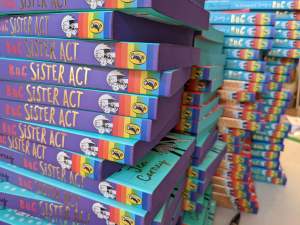
(as played by Billie and her class in The Accidental Diary of B.U.G. Sister Act)

Rules:

  1. You play this two at a time.
  2. Player 1 asks player two a question.
  3. Player two doesn’t answer it verbally.
  4. Player 1 asks player 2 another question.
  5. Player 2 gives the answer to the first question.
  6. Player 1 asks another question.
  7. Player 2 answers the second question they were asked
  8. …and so on until you’re bored or achieve a hilarious result.

Example:

Player 1: What day is it?

Player 2: (no answer)

Player 1: What was the last thing you ate?

Player 2: Saturday!

Player 1: What is your sister called?

Player 2: Weetabix

Player 1: Who are you going to buy a present for today?

Player 2: Lucy…

Tip: a bit of fore-thought works well! 😉

3. THAT DRIVER IS…

Rules:

Take it in turns to look at the drivers of vehicles you pass and assign them an adjective using sequential letters of the alphabet.

Example:

PLAYER 1: That driver is amazing

PLAYER 2: That driver is boring

PLAYER 3: That driver is careful

PLAYER 4: That driver is dangerous

TIP: It’s okay to pass or ask for help!

SUGGESTION: Play alternative versions of this game like ‘That driver is called…’ or ‘I be he/she likes…’ in which you essentially play the alphabet game using topics of your choice.

Example:

PLAYER 1: That driver is called Adam

PLAYER 2: That driver is called Bilal

PLAYER 3: That driver is called Christine

Example:

PLAYER 1: I bet she likes apples

PLAYER 2: I bet he likes burgers

PLAYER 3: I bet they like Coronation Street

4. COUNTING CARS

A basic game that my children loved when they were young.

Rules:

  1. Each player picks a colour.
  2. You set a time for the game to end e.g. “when we reach junction 34”, or “at 10 past 11.”
  3. Everyone counts how many vehicles of their colour they spot during that time period.
  4. The winner gets a toffee.

TIP: I like to pick a rare colour like brown so I can have a little sleep while the children are counting their red, black and white cars!!

WARNING! This games tests children’s honesty.

5. SILLY REGISTRATION PLATE PHRASES

Rules:

  1. Consider the registration plate of a vehicle in front of you.
  2. Using the string of three letters, take it in turns to make up a silly phrase.

E.g. LS15 GDF as above

Player 1: Gary dances funkily

Player 2: Get dressed, Freddy!

Player 3: Great dozy farmers

Everyone votes for their favourite then you choose another car.

TIP: wait for a car without an X!

Are we nearly there yet?

Yes.

Boo, I was enjoying that journey…😉

Categories
fostering Representation Uncategorized

Why do you represent a foster family in The Day My Dog Got Famous?

It’s no secret that I’m passionate about the representation of different types of families in children’s books. Indeed, a conversation with my son about the lack of positive representation of children with same-sex parents in upbeat books was my starting point for my debut series, The Accidental Diary of B.U.G., which has been praised for its accessible, age-appropriate inclusion – shortlisted for the national Polari Prize and winner of the Sparks Children’s Book Award. (You can read about that conversation in this blog post.)

In my latest series, I’ve represented a foster family. Specifically, a blended foster family headed up by two mums.

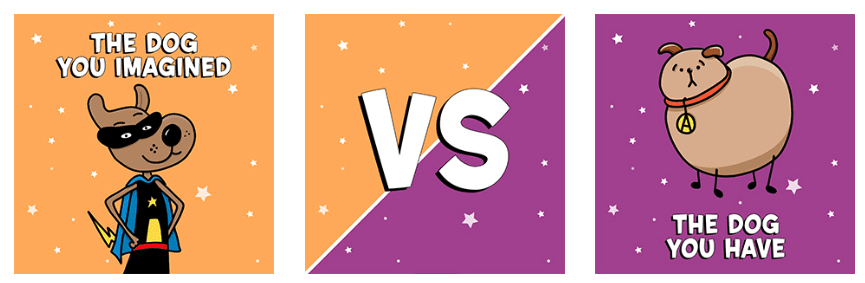
The series starts with The Day My Dog Got Famous which tells the story of Ferris (the mums’ birth child) and his mission (with the help of his newly-placed foster sister) to make his dozy dog more like the cartoon canine he draws for fun. Why? So he can beat his boastful next door neighbour and her uber-talented poodle in an online pet-popularity contest.

Teacher feedback: “The Day My Dog Got Famous doesn’t just show the wonder of dogs but presents a sensitive window into the life of a foster family, as well as the emotions of a young boy who has to deal with children coming in and out of his home for varying lengths of time.”

Real-Life Inspiration

I was inspired to write this series by my sister who, in addition to having four of her own children, has fostered for over 20 years. And by my nephews and niece who, like my protagonist, Ferris, have generously opened their lives and their hearts to welcome foster children into their home for various periods of time.

Through funny capers with dogs, cartoons and comic strips, The Day My Dog Got Famous explores some of the emotions experienced by birth children who are part of blended families: frustration, connection, love and loss.

Teacher feedback: “…not just a fabulous story but one that is highly inclusive and one that balances humour with heartache to absolute perfection.”

Representing Children in Foster Care

A mother through adoption myself, and a previous panel member for both fostering and adoption agencies, through the series I’ve also dipped into some of the reasons children can find themselves foster care, how they feel, and the repercussions that can ensue – all at a level that children will understand.

In book one,  The Day My Dog Got Famous, the family provides respite care for a child whose regular carer is in hospital.

In book twoThe Day My School Exploded, the family are fostering a child who has been removed from his mother and separated from his brother, and is soon going to be living with a relative.

Book three will focus on a child who is looked after under a Special Guardianship arrangement and comes to the Fosters (yes, the main family are called Foster as well as being foster carers!) for a respite placement.

All three books include a long-term foster child with additional needs to represent the sad fact that such children often remain in the care system for longer than their peers. (I’m an experienced parent to a wonderful child with special needs. Showing that children with additional needs are much more than just their difficulties was also important to me when writing this series.)

The message that family is often bigger than biology is seeded through the series.

Parent feedback: “Where the book tips the line to excellent is the touches of diversity and the truths of human life…Ferris having a ‘hard to place’ foster sister, and two mums, and what that impact that has. It looks at the how and who can be in care, for respite or permanent – and what that looks like for existing children.”

Why represent foster families in children’s books?

It’s always about mirrors and windows for me.

  1. REPRESENTATION – the mirror

Representation is the key to successful reading for pleasure – a well-known indicator of a child’s future life-chances and well-being.

In the UK alone, there are almost 54,000 foster families and approximately 70,000 foster children living with them.

These children deserve to see themselves in a funny book. As do the many birth children living in blended families.

2. EMPATHY – the window

Providing a sneak view into the life of someone else gives children with little (or no) experience of foster care the opportunity to learn about other children’s lives. This helps them to build empathy as they broaden their understanding of the world.


The Day My Dog Got Famous is out now and available via Amazon, Bookshop.org, independent bookshops, chain bookstores and libraries.

The Day My School Exploded will be released on 6th February 2025 and is available to pre-order now.

The third title will follow in February 2026.

Categories
Uncategorized

What was World Book Day Like for you?

It’s been a busy couple of weeks with all the wonderful World Book Day (AKA World Book Fortnight!) activities and events I’ve been lucky enough to be involved in.

Schools, libraries, theatres, bookshops – thank you so much for having me.

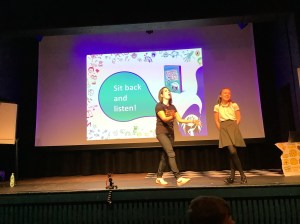
Audience participation in Answer The Question Before 🙂

It’s been completely brilliant to see children so enthused about books – laughing, sharing tales, dressing up as Billie, asking some inciteful questions and, best of all, telling me how much they love my series.

#Authorgoals – a potato of my protagonist – Billie Upton Green

Here are some of the most popular questions I got asked over the last couple of weeks and some short and sweet answers in case you’re interested:

When did you write your first book?

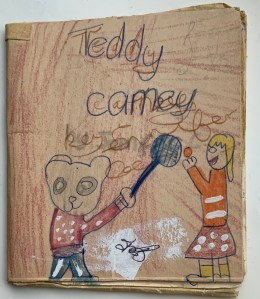
When I was seven. It was completely magpied from a book I loved to re-read when I was this age: About Teddy Robinson by Joan Robinson. Mine was called About Teddy Carney. The teddy lost his leg, played tennis and got a cap with the number 88 on it. Deep.

Practise makes…better…

What’s your favourite biscuit?

A question I love and one I often answer thus: A Tunnock’s Tea Cake – brilliantly dismantle-able; delicious to boot. Oddly, it doesn’t feature in TOBLA’s Biscuit Laws. Yet.

The first five Biscuit Laws in The Accidental Diary of B.U.G.

What inspired you to start writing?

  1. My mum. She wrote funny poems about my family and I loved her reading them to me.
  2. A teacher at High School called Mrs Gray who gave me tons of positive feedback and encouragement about my penmanship.
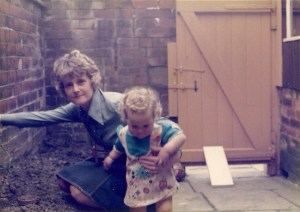
My lovely mum (and toddler me)

Have you had any other jobs?

Yes, many! Here’s a few of them: family learning tutor, KS2 teacher, working in a shoe shop, working in a bank, bid-writer, project manager, leaflet deliverer.

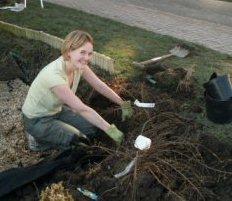
Here’s me working as a project manager on a gardening project

Why did you write this series?

I wanted to make sure that my children (and subsequently children all across the country/world) had the option to read a funny and interactive book that featured a main character who was happily adopted by two mums – because that’s what my son wanted when he was 10.

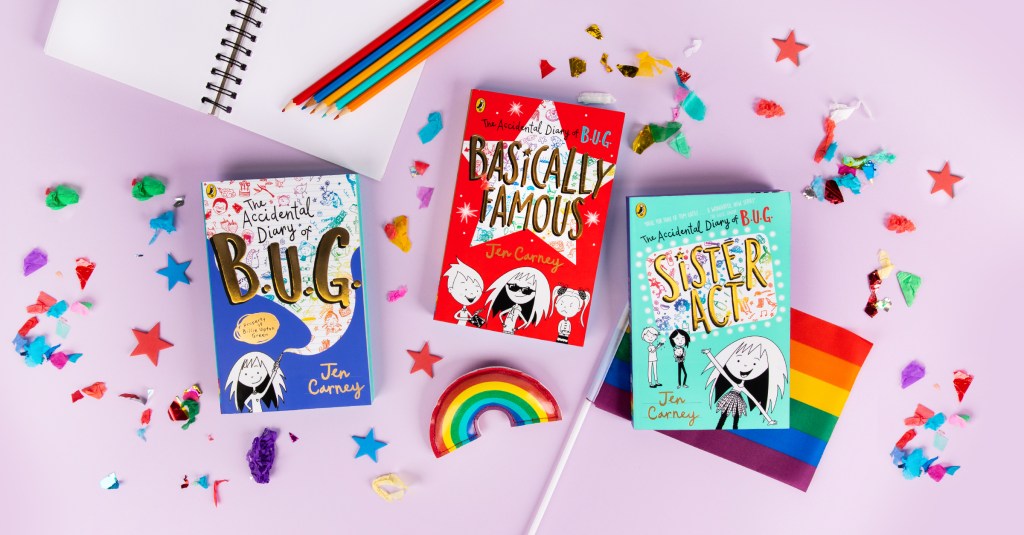
There are currently three books in The Accidental Diary of B.U.G. series. You can order them here if you like!

How long does it take to write a book?

Tricky. For me, writing a first draft might take about four months (predominantly working 9.30-2.30 Monday to Thursday). But the rest of the process takes much longer – working with an editor to make everything shine, the illustration process etc. It can take over a year for a book to get from an idea in my head to being available in a shop.

Some of the books I’ve recently signed for Ebb & Flo bookshop

How old are you?

I like to answer this question, and the one about how long I’ve been writing, with a maths problem.

My age is 9 x 5, half of 90, three lots of 15

I started writing stories when I was seven. That was in 1983.

(This detail is correct as at 13th March 2022!)

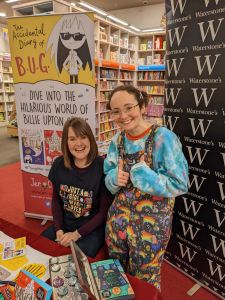
Me and Rachel – the wonderful children’s bookseller at Waterstones in Warrington. Say cheese!

Do you have any tips for writing funny books?
Keep a notebook handy. When you see/hear/think of something funny, write it down for reference. Test your material out on your intended audience. Be prepared to make some drastic cuts!

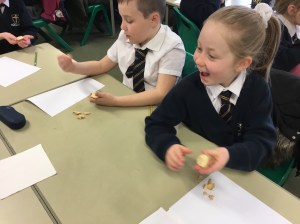
A child laughing…I think because she’s been allowed to dismantle a custard cream in class.

What’s your favourite book?

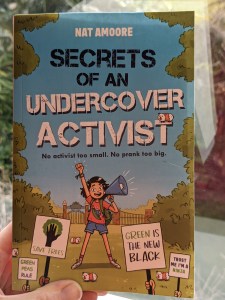
I honestly don’t have one. I love reading all sorts of books. When I’m asked this question by children, I often recommend a book I’ve recently read and enjoyed. This week I read a couple of advanced reader copies of books I loved, both of which are out later in 2022: Secrets of An Undercover Activist by Nat Amoore and My Name is Sunshine Simpson by G.M. Linton. I do love realistic, contemporary stories with humour and heart.

#authorperks …publishers send you early reader copies of brilliant books like this.

Can you tell us a joke?

My answer here varies. Here’s an oldie, but a goodie: Knock knock. (Who’s there?) Europe…

I’d like to finish this blog with some HUGE thank yous to the following schools and organisations for inviting me to connect with readers during this bookish time of the year:

Orpington Library Chatterbooks group, The NENE Trust schools, Tameside Libraries, Albany Academy, Coleham Primary School, Horwich Parish C of E, St Joseph’s RC Primary, Woodside Junior School, Chorley Theatre, Ebb & Flo Bookshop and all the schools in Chorley who attended my World Book Day live event either in the theatre or via the livestream, Boldmere Primary, The Vineyard School, Hull Schools Library Service, Hampshire Schools Library Service.